


Small Business Analytics: What to Track (So You Don’t Lie to Yourself)
Boston Made, Inc.Office of the Founder & CEO
From the desk of Nathan StricklandBoston, Massachusetts ·
Dear Sir or Madam,
Analytics doesn’t exist to make you feel good.
Analytics exists to tell the truth.
And in small business marketing, truth is rare — because most people accidentally build a dashboard that lies.
They’ll say things like:
- “We got 2,300 website visits this month!”
- “Our traffic doubled!”
- “SEO is working!”
- “Facebook is bringing people in!”
And then you ask the only question that matters:
“How many leads did you get?”
…and the room goes quiet.
Because the whole business has been celebrating numbers that don’t pay bills.
So today, Fenway Web is going to break down:
✅ what to track
✅ what NOT to track
✅ and how to build analytics that helps your business grow
(not just look busy)
Step One: Understand the Only Metric That Matters
Before we talk about dashboards…
let’s get one thing straight.
Traffic isn’t success.
Leads are success.
Revenue is success.
Traffic is just potential.
Potential means nothing unless it becomes action.
So the first rule is:
Never trust analytics that doesn’t tie back to leads.
The Big Analytics Mistake: Tracking Vanity Metrics
Vanity metrics are numbers that look impressive but don’t connect to sales.
Examples:
- total sessions
- total pageviews
- time on site
- bounce rate (by itself)
- follower growth
- impressions
Are these useless?
No.
But they’re not “results.”
They’re activity.
And activity can be completely unrelated to money.
What You SHOULD Track: The Business Metrics That Don’t Lie
At Fenway Web, we track action.
Here’s the core list.
1) Conversion Events (Your Website’s Paycheck)
If your website is meant to generate leads, you must track:
✅ Contact form submissions
✅ Calls (tap-to-call clicks on mobile)
✅ Quote request submissions
✅ Booking confirmations
✅ Email clicks
✅ “Get Estimate” button clicks
✅ Lead magnets (downloads)
✅ Checkout purchases (if ecommerce)
These are conversion events.
If you’re not tracking these…
you don’t have analytics.
You have decorations.
2) Lead Sources (Where Winners Come From)
This is where most businesses mess up.
They track:
- “traffic by channel”
But what you need is:
“leads by channel”
Because some channels bring traffic that never converts.
And other channels bring fewer visitors…
but the visitors actually buy.
✅ Track conversions by:
- Organic search
- Google Business Profile
- Paid ads
- Referral links
- Direct traffic
- Email campaigns
This answers:
“What’s actually working?”
3) Cost Per Lead (CPL)
Small business marketing becomes simple when you track CPL.
If you spend:
- $300/month on ads
and get: - 10 leads
Your CPL is $30.
Now you can make real decisions.
✅ If CPL is low = scale it
❌ If CPL is high = fix or kill it
No emotions.
No guessing.
Just business.
4) Call Quality (Not Just Call Volume)
Calls are tricky.
Some calls are junk.
Some are gold.
A real analytics system tracks:
- calls as a conversion
- and call quality outcomes
✅ Examples:
- booked appointment
- quote requested
- answered / missed
- duration (long calls usually mean higher intent)
A 45-second call isn’t the same as a 7-minute call.
5) Form Completion Rate
This is a sneaky conversion killer.
People start forms…
then abandon them. Why?
- too many fields
- unclear next step
- slow load
- poor mobile layout
✅ Track:
- form starts vs completions
If your form completion rate is low…
your website is leaking money.
6) Page-Level Conversion Performance
You need to know which pages produce leads.
Not just visits.
✅ Track:
- top landing pages by leads
- top service pages by lead conversion
- top blog posts that create leads
This is how you decide:
- what to improve
- what to expand
- what to delete
The Honest Truth: Google Analytics Alone Isn’t Enough
Google Analytics is great…
but it’s not the full story.
Because small business leads often happen through:
- phone calls
- texts
- direct messages
- walk-ins
- email replies
So a real tracking system includes:
✅ call tracking (optional but powerful)
✅ form tracking
✅ booking tracking
✅ CRM logging (even basic spreadsheets)
Because reality happens outside GA4.
What NOT To Track (Or You’ll Lose Your Mind)
Here’s what we recommend avoiding obsessing over:
❌ Bounce rate
❌ Session duration
❌ “Top pages by page views” without conversions
❌ Impressions
❌ Rank tracking without lead tracking
These can become psychological traps.
They make you chase performance theater instead of performance.
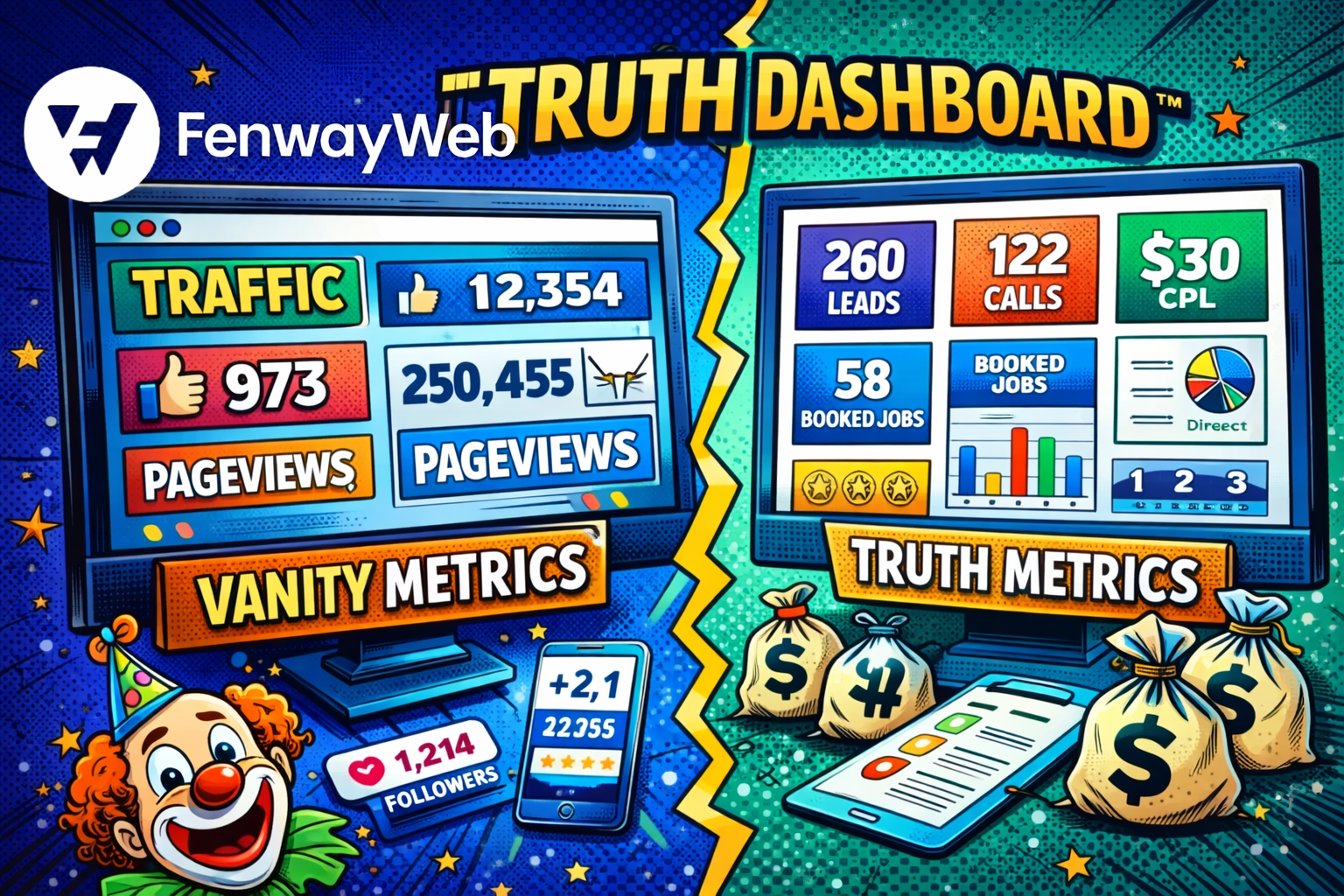
The Fenway Web “Truth Dashboard”
If we were building a dashboard for a service business today, it would show:
✅ Monthly Leads
- total form submissions
- total calls
- total bookings
✅ Leads by Channel
- organic
- GBP
- paid
- social
✅ Cost Per Lead
- by channel
✅ Missed Leads
- missed calls
- form abandonment
✅ Top Conversion Pages
- service pages that convert best
This becomes your real scoreboard.
Final Word: Analytics Isn’t for Flexing. It’s for Winning.
The goal isn’t to say:
“Look at our traffic!”
The goal is to say:
“We know exactly where our leads come from.”
“We know what it costs.”
“We know what to scale.”
“We know what to fix.”
That’s not marketing fluff.
That’s business clarity.
And clarity is power.
Want Fenway Web to Set Up Real Tracking?
If your analytics are confusing, inflated, or disconnected from leads…
Fenway Web can build your tracking system the right way:
- conversion events
- lead attribution
- form + call tracking
- performance dashboard
So you stop guessing…
and start scaling.


