


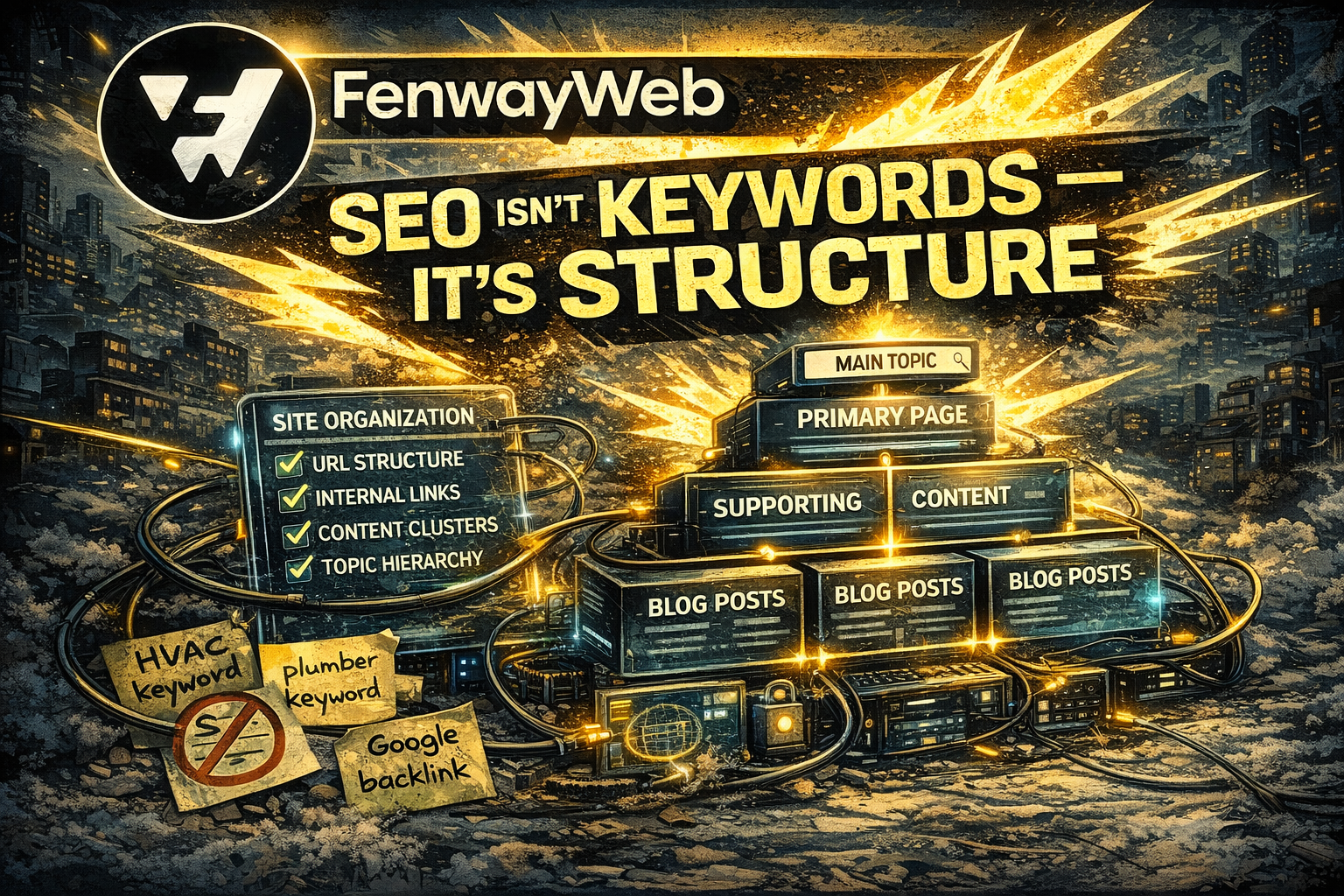
SEO Isn’t Keywords — It’s Structure
Boston Made, Inc.Office of the Founder & CEO
From the desk of Nathan StricklandBoston, Massachusetts ·
Dear Sir or Madam,
Why the websites that rank aren’t always “better”… they’re organized.
Most people think SEO is about keywords.
They think SEO is:
- stuffing phrases into paragraphs
- repeating “best HVAC company near me”
- buying backlinks
- throwing blogs on a site every week
- hoping Google notices
And yes — keywords matter.
But keywords alone don’t make you rank.
In fact, one of the biggest reasons businesses fail with SEO is because they focus on the wrong thing:
They focus on what to write…
instead of how the website is built.
Because Google doesn’t reward effort.
Google rewards structure.
That’s why Fenway Web approaches SEO differently.
We don’t treat SEO like “content writing.”
We treat SEO like digital architecture.
And the truth is:
SEO isn’t keywords — it’s structure.
Structure is what makes Google understand you.
Structure is what makes pages rank.
Structure is what makes traffic multiply instead of scatter.
SEO Is Not a Marketing Trick — It’s a Map
Think of Google like a GPS.
Google doesn’t randomly suggest businesses.
Google suggests businesses that are:
- clear about what they offer
- consistent in how they organize information
- proven trustworthy
- easy to crawl
- easy to understand
- built around real topics
SEO is simply Google asking:
“Do we trust this website enough to recommend it?”
And the answer often depends less on writing…
and more on how the information is structured.
Why Keywords Alone Don’t Work Anymore
In the early days, you could rank by repeating a phrase.
That era is gone.
Now Google looks at signals like:
- page experience
- topical relevance
- internal linking logic
- schema markup
- content depth
- authority
- clarity
- user engagement behavior
- consistency across the site
And Google’s biggest goal is:
Give the searcher the best, most reliable answer.
Keyword stuffing does not look reliable.
Structure looks reliable.
The 3 Types of SEO (And Why Structure Controls All of Them)
Fenway Web breaks SEO into 3 layers:
1) On-Page SEO
Headlines, copy, metadata, image alt tags, readability.
2) Technical SEO
Speed, code cleanliness, mobile performance, indexability, sitemaps.
3) Structural SEO (The Layer Most Businesses Ignore)
Site architecture, page hierarchy, topical clusters, internal linking.
Most people only try #1.
Some try #2.
Almost nobody builds #3.
But #3 is what turns a website into a ranking machine.
What “Structure” Means In SEO
Structure is the way your website communicates with Google and visitors.
It answers questions like:
- What is this site about?
- What topics does this site own?
- What pages matter most?
- What services are offered?
- What supporting content exists?
- How do pages relate to each other?
- What is the hierarchy?
- What should rank first?
Google can’t rank what it can’t understand.
And it can’t understand websites that are:
- messy
- repetitive
- disorganized
- unlinked
- missing core pages
- filled with thin content
Fenway Web builds sites like organized libraries, not messy closets.
The Most Common SEO Failure: Random Content
Here’s what many businesses do:
They publish blogs like:
- “5 Tips for Winter Maintenance”
- “Why We Love Our Customers”
- “Things to Know Before Hiring Us”
- “What Makes Us Different”
But these posts aren’t connected.
They’re not structured into a cluster.
They don’t support a core service page.
So Google sees them as isolated content islands.
That means:
- no topical authority
- no ranking momentum
- no internal link power
- no direction
Structure solves this.
The Fenway Web SEO Blueprint: Build Your Website Like a Topic Tree
To rank consistently, your website needs a clear topic hierarchy.
Imagine a tree.
The trunk is your core service:
Example: “Web Design”
The big branches are your service categories:
- WordPress Website Development
- Ecommerce / WooCommerce
- SEO Services
- Branding
- Website Maintenance
The smaller branches are supporting topics:
For SEO:
- local SEO
- on-page SEO
- technical SEO
- content strategy
- internal linking
- Google Business Profile
Leaves are blog posts / FAQs:
These support the branches and feed authority back into core service pages.
This is why clusters rank.
It’s not because they’re longer.
It’s because they’re connected.
Service Pages Are SEO Assets (Not Just Sales Pages)
Most businesses treat service pages like short brochures.
That’s a mistake.
Google ranks pages that demonstrate:
- clarity
- depth
- purpose
- helpfulness
Fenway Web builds service pages as ranking assets by including:
- clear service definitions
- who it’s for
- problems it solves
- process breakdown
- FAQs (huge for SEO)
- internal links to related topics
- proof and trust signals
- strong CTAs
A service page should do 2 jobs:
✅ rank in Google
✅ convert visitors into leads
If it does only one, you’re leaving money on the table.
Internal Linking: The Hidden Power Most Sites Never Use
Internal linking is one of the most underrated SEO weapons.
Because links tell Google:
- what pages matter
- how topics are connected
- what the website “knows”
- where authority should flow
Here’s how Fenway Web does internal linking strategically:
- Blog posts link to the related service page
- Service pages link to proof/portfolio pages
- Portfolio pages link back to services
- About page links to key services
- Homepage funnels visitors into service clusters
- Footer links reinforce priority pages
Internal links turn your site into an organized system.
Without them, pages sit alone and die quietly.
URL Structure: Simple = Strong
Google loves clean URL structure.
Bad structure looks like:
- /page-id-23893/
- /services-copy-copy/
- /new-page-final-2/
- /category/uncategorized/seo-tips/
Good structure looks like:
- /services/
- /services/web-design/
- /services/seo/
- /portfolio/
- /blog/
- /contact/
Clean URLs:
- increase trust
- increase click-through
- increase crawl clarity
- make analytics easier
- make scaling easier
Structure is a long-term investment.
Headers Matter: H1, H2, H3 Isn’t “Formatting” — It’s SEO Communication
Most people use headers based on looks.
That’s wrong.
Headers are meaning.
Your H1 is the main identity of the page.
Your H2 sections define topic depth.
Your H3s support those topics.
This creates:
- scanability for humans
- structure for Google
- stronger relevance signals
Fenway Web treats headings like architecture — because they are.
Schema: Structure That Google Reads Like Code
Schema markup is structured data.
It tells Google:
- this is a business
- these are the services
- this is the address
- these are the reviews
- these are FAQs
Schema doesn’t always visibly change your website…
but it absolutely changes your SEO strength.
And in competitive industries, schema can be a difference-maker.
What Google Really Rewards In 2026
Google wants a website that feels like the authority.
That means:
- clear business identity
- fast load speed
- real proof
- content depth
- helpful answers
- structured topic coverage
- consistent branding
- internal linking logic
SEO is not a hack.
SEO is simply building a website that deserves to be recommended.
Fenway Web Builds SEO Systems, Not SEO Tricks
This is why Fenway Web wins.
We don’t chase trends.
We don’t keyword stuff.
We don’t publish random articles hoping something sticks.
We build:
✅ page structure
✅ topic clusters
✅ internal linking
✅ service architecture
✅ technical performance
✅ conversion flow
Because ranking is not luck…
Ranking is structure.
Final Thought: Keywords Are Paint — Structure Is the Blueprint
Keywords are still important.
But keywords without structure are like painting a house with no foundation.
The paint won’t save it.
If you want to rank long-term…
If you want consistent lead flow…
If you want SEO that gets stronger over time…
You don’t start with keywords.
You start with structure.
That’s Fenway Web.


