

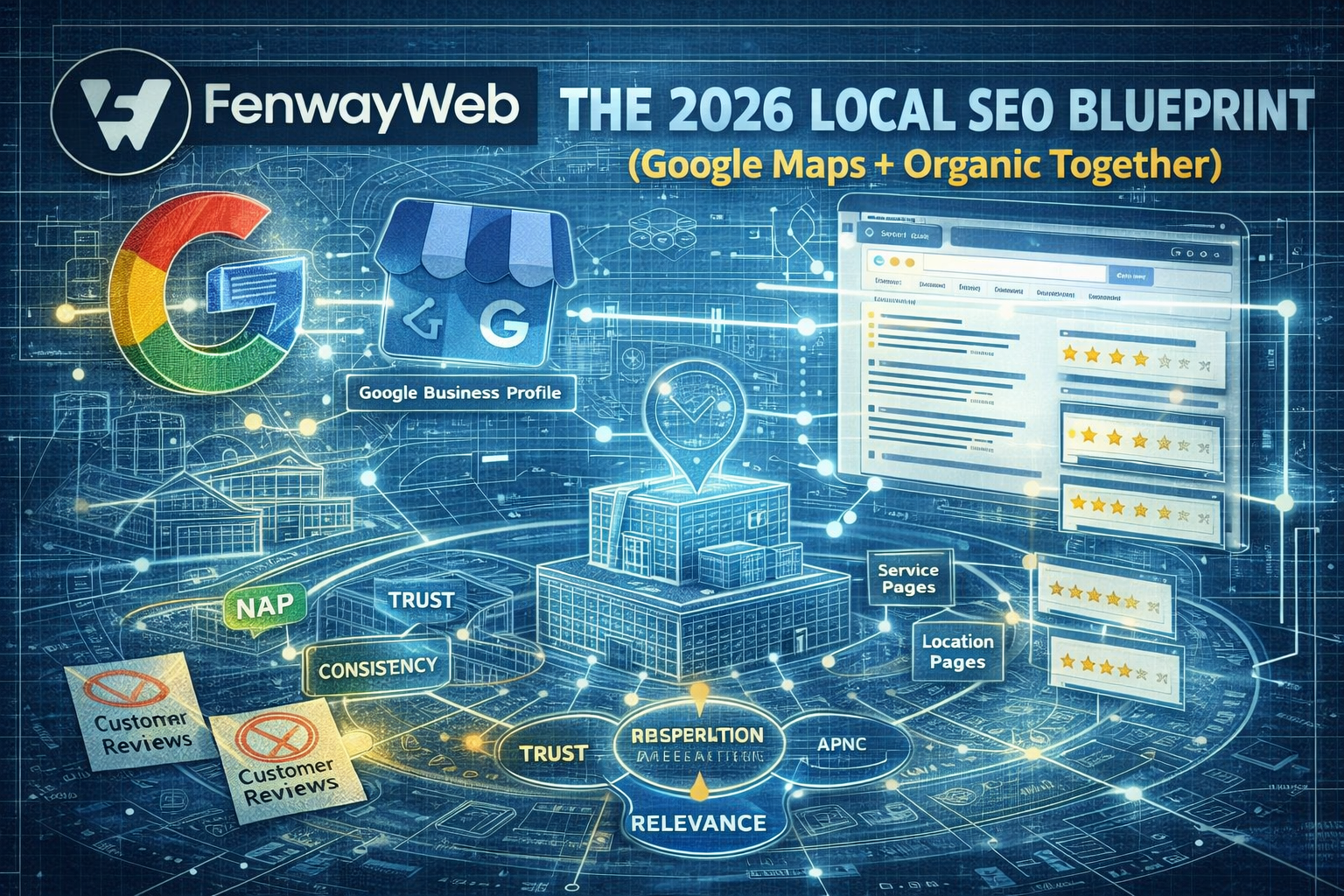
The 2026 Local SEO Blueprint (Google Maps + Organic Together)
Boston Made, Inc.Office of the Founder & CEO
From the desk of Nathan StricklandBoston, Massachusetts ·
Dear Sir or Madam,
How to dominate your town online by building one connected ranking system.
If you’re a local business, there’s one goal that matters more than almost anything else:
When someone searches for what you do — you show up.
Not only on Google…
But in the right places:
✅ Google Maps (the “Map Pack”)
✅ Organic search results
✅ Your service pages
✅ Your reviews
✅ Your photos
✅ Your business information
✅ Your website credibility
Because local SEO is no longer “a thing you do.”
It’s the difference between:
- constant calls
- and constant dead silence
And in 2026, the businesses winning local search are not necessarily the best businesses…
They’re the best structured businesses.
At Fenway Web, we treat local SEO like a blueprint — not a trick.
Because local SEO isn’t just about ranking.
It’s about becoming the most recommendable business in your area.
The Big Mistake: Separating Google Maps From Your Website
This is the #1 local SEO mistake we see:
Businesses treat their Google Business Profile as one thing…
and their website as another thing.
They’ll “work on their website” one month.
Then “work on Google Maps” later.
But Google doesn’t work that way.
Google ranks businesses based on connected signals.
So in 2026, the winning strategy is simple:
Your Maps presence and your website must work together as ONE system.
Your Google Business Profile validates your business locally.
Your website proves relevance, authority, and legitimacy.
Together?
They create local dominance.
What Local SEO Really Is (In Plain English)
Local SEO is Google asking:
“If someone in this town needs this service today, which business should we confidently recommend?”
Google wants to avoid:
- spam
- fake listings
- low-quality providers
- businesses with inconsistent info
- businesses that don’t respond
- businesses with bad customer experiences
So Google uses signals like:
- proximity
- relevance
- prominence
- trust
- consistency
- activity
- engagement
The businesses who understand those signals win.
The 2026 Local SEO Blueprint (Fenway Web System)
Here’s Fenway Web’s Local SEO blueprint broken down into the core pillars.
This is the structure that wins.
Pillar 1: Google Business Profile Optimization (Your Maps Foundation)
Your Google Business Profile (GBP) is your local identity card.
If your GBP is weak, you won’t compete — even with a great website.
✅ The Fenway Web GBP checklist:
- Accurate business name (no keyword spam)
- Correct primary category and secondary categories
- Service areas set correctly
- Hours updated
- Phone number consistent with website
- Website link connected properly
- Description written strategically (not generic)
- Products/Services section built out
- Appointment link added (if applicable)
Why this matters:
Google Maps is heavily influenced by:
- completeness
- accuracy
- activity
- trust
An incomplete profile is a ranking disadvantage.
Pillar 2: NAP Consistency (The Internet Must Agree You Exist)
NAP means:
- Name
- Address
- Phone
In 2026, Google heavily punishes confusion.
If one directory says:
“Fenway Web LLC”
and another says:
“Fenway Web”
and another says:
“FenwayWeb”
Google sees uncertainty.
Same with phone numbers and addresses.
✅ Fenway Web Local SEO rule:
Your NAP must match exactly across:
- your website
- Google Business Profile
- Yelp
- Bing Places
- Apple Maps
- YellowPages
- industry directories
- local chamber listings
- citation platforms
Local SEO rankings can rise dramatically simply by correcting inconsistency.
Because consistency builds trust — and trust ranks.
Pillar 3: Reviews Aren’t Optional Anymore (They Are a Ranking Factor)
Reviews are not just social proof.
They influence:
✅ rankings
✅ click-through
✅ conversions
✅ trust
✅ response rate
Google wants to rank businesses people love.
So you need:
- more reviews
- better reviews
- recent reviews
- responses to reviews
The Fenway Web review system:
- ask after completion of service
- send a link via SMS
- follow up once (politely)
- respond to every review
Even negative reviews, handled professionally, can boost credibility.
A silent review profile looks inactive.
Google prefers active businesses.
Pillar 4: Location + Service Page Architecture (Where Most Businesses Lose)
This is where Fenway Web outperforms most competitors.
Most local businesses have one page that tries to rank for everything.
That doesn’t work anymore.
In 2026, you need structured pages:
- a core Services page
- individual service pages
- optional location pages (if needed)
- internal linking between them
Example structure:
- /services/
- /services/wordpress-websites/
- /services/local-seo/
- /services/website-maintenance/
- /locations/your-city/
- /locations/nearby-city/
Google ranks specificity.
So pages need specific intent.
That’s how you become relevant for:
- “web design in Dalton GA”
- “local SEO in Dalton”
- “WordPress developer near me”
- “website maintenance in [city]”
One homepage can’t carry all that.
Structure wins.
Pillar 5: On-Page SEO That Actually Supports Local Intent
On-page SEO is not keyword stuffing.
It’s clarity.
✅ What Fenway Web optimizes for local ranking:
- page titles (service + location)
- meta descriptions written like ads
- H1 headline with service intent
- supporting H2 structure
- internal links to relevant pages
- embedded map on contact/location page
- FAQ sections with real questions people ask
Google rewards helpfulness.
When you build pages that truly answer questions, rankings follow.
Pillar 6: Local Content That Builds Topical Authority (Not Random Blogs)
Most businesses blog randomly.
That doesn’t build authority.
Authority is built through clusters.
Fenway Web Local Content Strategy:
Write content that supports services, such as:
- “How much does [service] cost in [city]?”
- “Best time of year to do [service]”
- “Common mistakes homeowners make with [problem]”
- “What to expect when hiring a [contractor type]”
These posts rank AND convert because they match real buyer intent.
Pillar 7: Map Pack + Organic Ranking = The Double Win
Here’s the real win:
✅ Map Pack visibility gets you calls fast
✅ Organic visibility gives long-term compounding traffic
Businesses that do both become hard to beat.
Because even if a competitor outranks you in one spot…
you still show up everywhere else.
That’s why Fenway Web builds local SEO like a full ecosystem, not a single tactic.
Pillar 8: Behavioral Signals (Google Watches What People Do)
This is the part people don’t talk about enough.
Google watches:
- clicks
- calls
- direction requests
- time on site
- bounce rate
- return visits
- engagement on your listing
- photo views
Meaning:
User experience affects ranking.
If your website is slow or confusing…
people bounce…
and your local SEO suffers.
This is why Fenway Web builds sites that aren’t just pretty.
They’re fast and clear and conversion-ready.
The Fenway Web Local SEO Strategy in One Sentence
Here’s the whole blueprint summarized:
Build a Google Business Profile that is complete and active… then support it with a website that has clean service structure, location relevance, reviews, and trust signals — all connected by internal linking.
That’s how you win local search in 2026.
Not by tricks.
Not by keywords alone.
Not by hoping.
By systems.
Final Thought: Local SEO Is The New Word-of-Mouth
Local SEO is word-of-mouth at scale.
Because when someone searches…
Google becomes the recommender.
And Fenway Web helps brands become the business Google recommends.
If you want to dominate your town online, you don’t just need a website…
You need a connected local SEO system.
That’s what Fenway Web builds.


